How we teach, and how we measure your progress
How do you know you are really learning a language? Many programs answer with the number of lessons completed or a finished textbook. At IES we answer with a different question: what can you do with the language today that you couldn't do before?
To answer it clearly, we bring together two things: an independent standard that measures language proficiency, the ACTFL® Proficiency Guidelines, and our own method, refined since 1982, the IES Six-Step Methodology™. The Guidelines tell us where we are going. The Six Steps are how we get there.
What are the ACTFL Proficiency Guidelines?
ACTFL (American Council on the Teaching of Foreign Languages) is the professional organization for language educators in the United States. Its Proficiency Guidelines were first published in 1986, and the most recent edition is from 2024. They describe what a person can do with a language in real, unrehearsed situations, across four skills measured separately: speaking, listening, reading and writing.
The Guidelines organize language ability into five major levels, like a staircase. The first three each have three steps: low, mid and high.
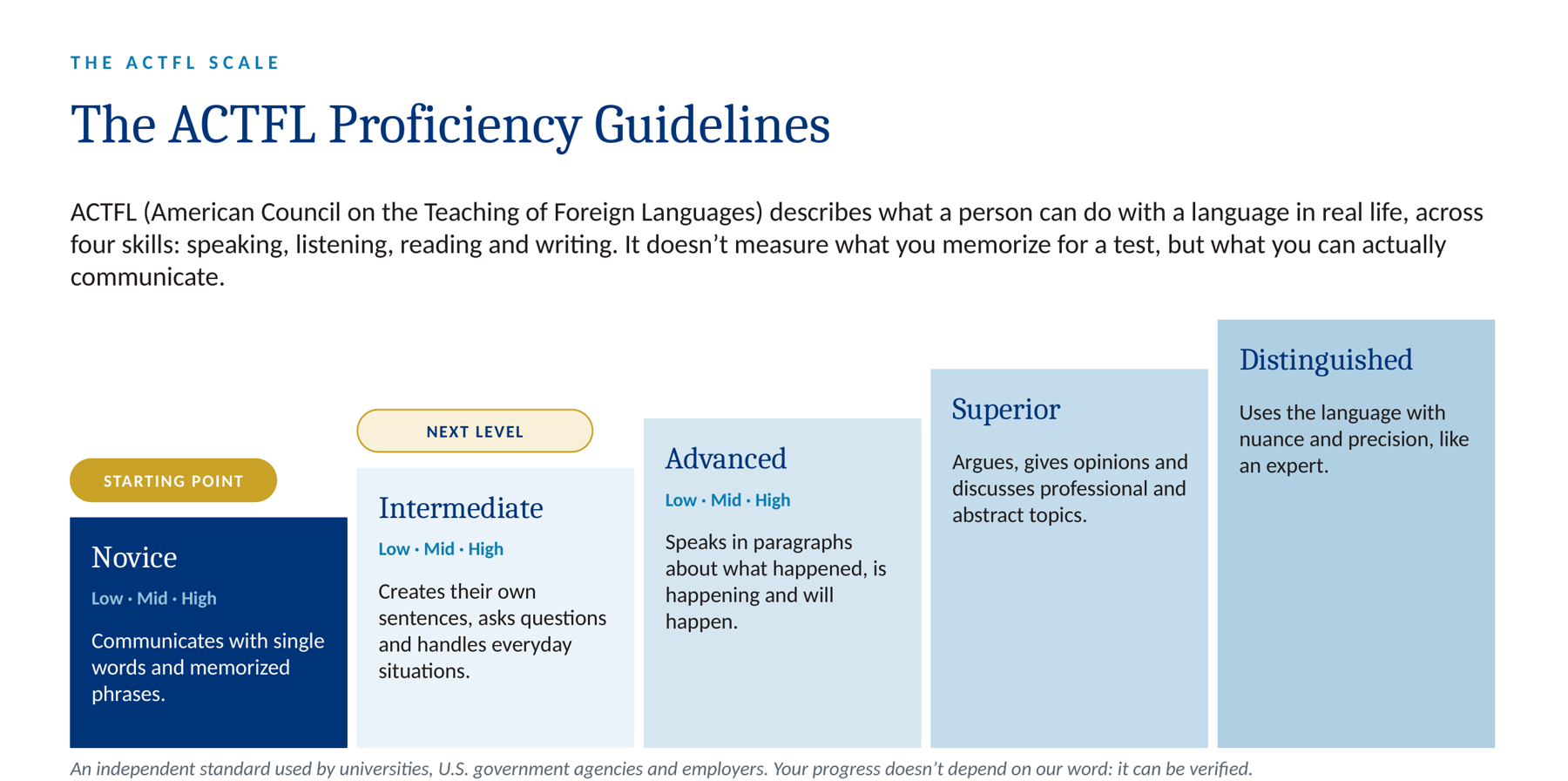
- Novice: communicates with single words and memorized phrases.
- Intermediate: creates their own sentences, asks questions and handles everyday situations.
- Advanced: speaks in paragraphs and narrates what happened, what is happening and what will happen.
- Superior: argues a point, gives opinions and discusses professional and abstract topics.
- Distinguished: uses the language with precision and nuance, like an expert.
These descriptions are our own plain-language summary. The official text is on the ACTFL website.
What they measure, and what they don't
The Guidelines measure what you can actually communicate, not what you memorize for a test. To place someone on the scale, they look at four things:
- Which tasks you can handle: greeting, asking for information, explaining a problem, negotiating.
- How accurately: grammar, vocabulary and language that fits the situation.
- In which situations and topics: from everyday life to professional settings.
- How long and complex the language is: words, sentences, paragraphs or extended speech.
What they don't measure is where, how or for how long you studied. That is why the same scale works for an elementary student and for an adult who picked up English on the job: what counts is what you can do today.
What they mean for adult learners
In our English for Professionals program, the ACTFL Guidelines give you three things a traditional course rarely does:
- An exact starting point. Before you begin, you take a placement assessment in all four skills: reading and writing online, and speaking and listening in a Zoom call. Many adults discover they read far better than they speak, or understand more than they dare to say. That changes how we teach you.
- Realistic goals tied to your work. Instead of promising "fluency in three months," we show you which step is reachable with the time and class schedule you choose, and what you will be able to do at work when you get there: answer a call, reply to an email, explain a service to a customer.
- Progress you can verify. During the program we repeat the assessment on the same scale. Your results don't depend on our word: you see where you started and where you are now.
Every student receives a personal report with their level in each skill, explained in plain language, and an honest recommendation of how many classes they need to reach their goal.
What they mean in our K–8 schools
Our in-school language programs, from TK through 8th grade, are also aligned with the ACTFL Guidelines. In the early grades, children listen, understand and imitate before they produce, just as the scale describes at the Novice level. In middle school, our Grammar Connections continuum takes students in grades 5 through 8 from developing communicators to independent communicators, working in the three modes of communication ACTFL uses: interpretive (understanding what you hear and read), interpersonal (exchanging ideas with another person) and presentational (speaking or writing for an audience).
For schools and families, that means a clear progression from one grade to the next, and a shared language for talking about each student's growth.
How it fits together: the IES Six-Step Methodology™
The ACTFL Guidelines tell us where we are going, but not how to teach. That is our work. The IES Six-Step Methodology™ is our own method, created and refined in classrooms since 1982. It follows the natural order in which we all learned our first language: understand first, then produce.
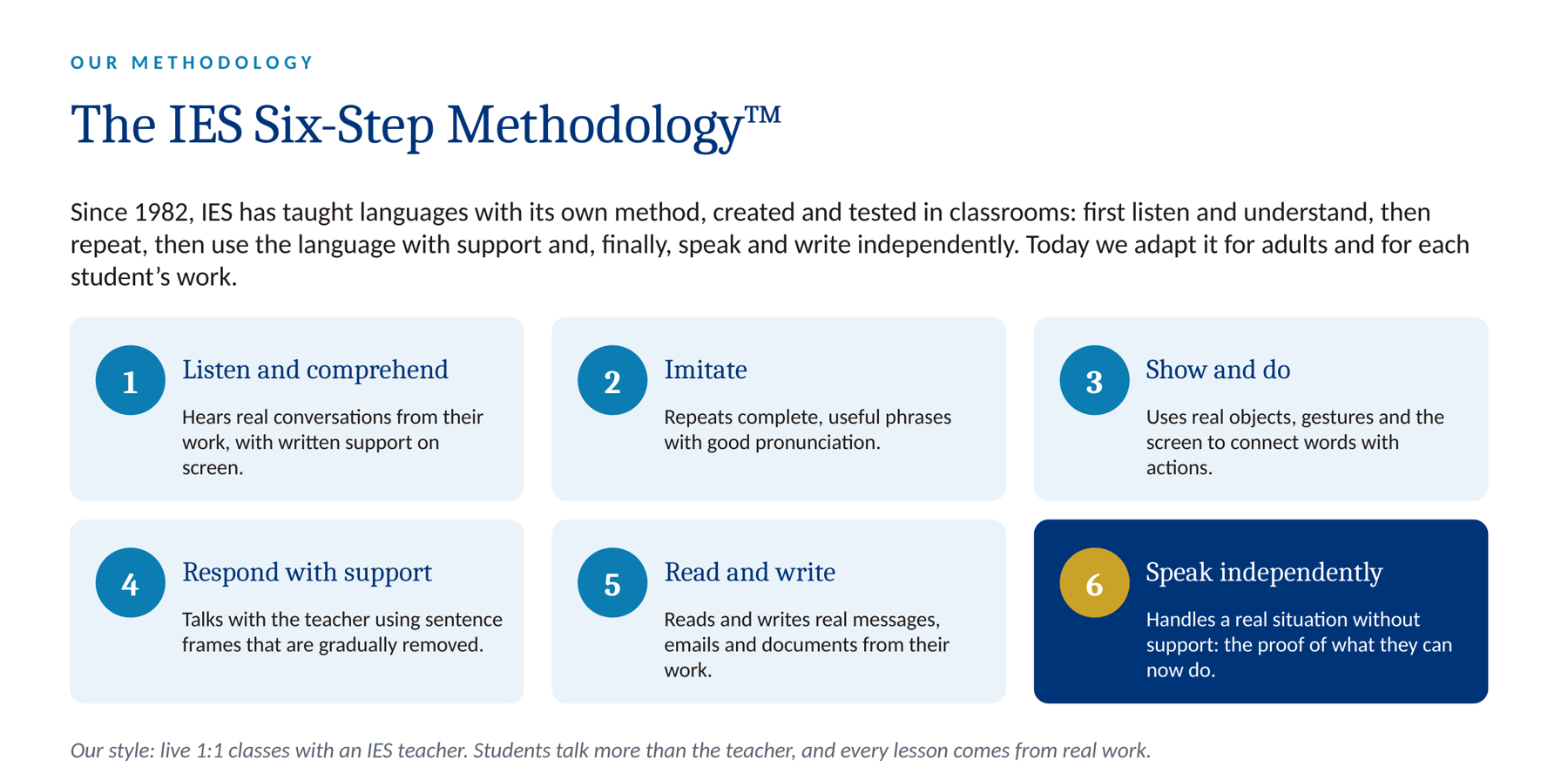
- Listen and comprehend: the student listens to real conversations, with visual support.
- Imitate: repeats complete, useful phrases with good pronunciation.
- Show and do: connects words with objects, gestures and actions.
- Respond with support: talks with the teacher using sentence frames that are gradually removed.
- Read and write: reads and writes real texts: messages, emails, documents.
- Speak independently: handles a real situation without support. It is the proof of what the student can now do.
Each step builds one of the skills ACTFL measures, and step 6 produces exactly what the scale assesses: real, spontaneous communication. That is why the two fit together: the Six Steps are the path of every class, and the ACTFL scale is how we confirm the path is working.
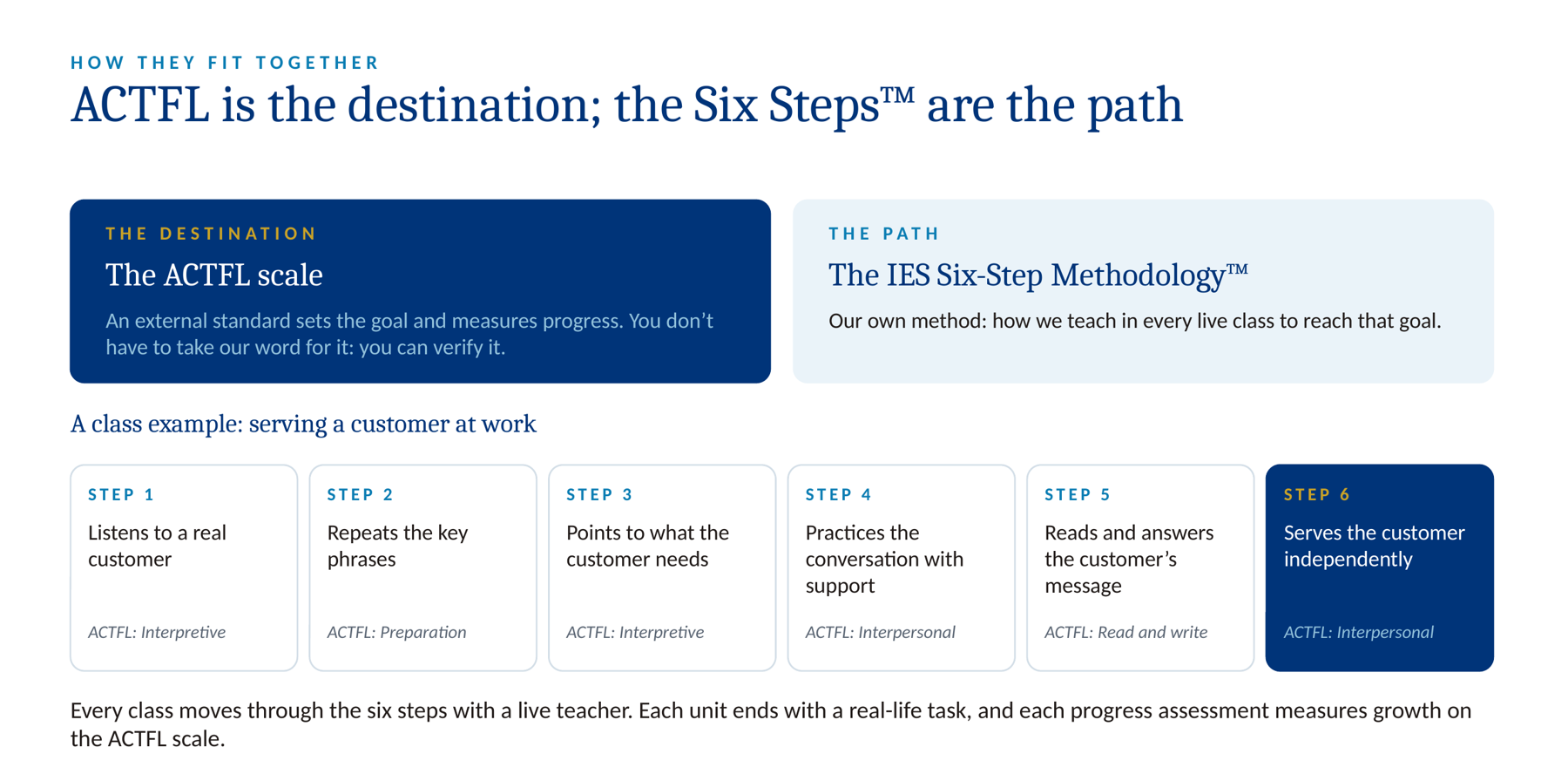
For adults, the method comes to life in live, one-on-one classes with an IES teacher, and every class is built around the student's real work: a customer who calls, a home repair visit, an email that needs an answer.
Start by knowing where you are
The first step is your placement assessment. In under an hour online and a short Zoom call, you will know exactly which step you are on in each skill, and what is realistic to achieve with the time you have.
ACTFL® is a registered trademark of ACTFL, Inc. IES Language Foundation is not affiliated with or endorsed by ACTFL. Our programs are aligned with the ACTFL Proficiency Guidelines 2024; the descriptions on this page are our own summary. IES Six-Step Methodology™ is a trademark of IES Language Foundation.
Sources: ACTFL Proficiency Guidelines 2024 · ACTFL: Revised Proficiency Guidelines Released